
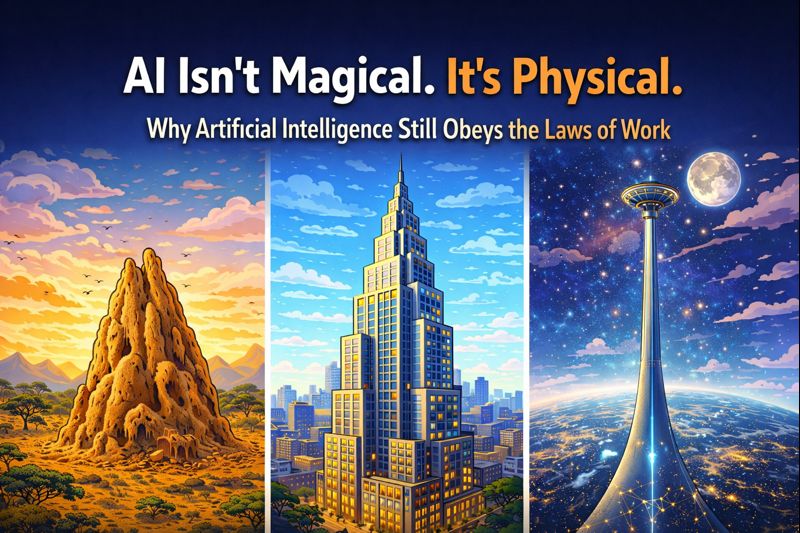
We talk about AI as if it arrived from a different universe and operates by different rules. As if the moment intelligence became artificial, the laws that govern everything else somehow stopped applying. They didn’t! AI exists in the same physical reality humans do. It runs on energy. It consumes resources. It is constrained by time, coordination, error propagation, and bottlenecks. Because of that, it is governed by the same immutable laws that have shaped work, production, and performance for millennia. AI isn’t a new species of intelligence (per se), but it’s a much faster one. That distinction really matters.
Speed Changes Outcomes, Not Rules
Whenever something gets dramatically faster, people confuse acceleration with transformation. A wildfire looks nothing like a campfire, but both obey the same chemistry. A skyscraper looks nothing like a termite mound, but both obey the same physics. The difference isn’t the rules. It’s the scale, the energy, and the cost of mistakes. AI is no different. What we’re seeing isn’t the birth of a magical mind. It’s the compression of cognitive labor into machine time. Tasks that once took days now take seconds. Coordination that once required meetings now happens instantly. Errors that once took months to surface now cascade immediately. Same work. Faster clock.
Why Swarms Are Replacing Monoliths
Early AI systems were designed as monolithic minds: one model, one brain, one all-purpose entity expected to do everything reasonably well. The focus has largely remained on making that single mind more accurate, more capable, and faster. That approach is already breaking down. Not because AI needs human personalities, but because the “Physics of Work” still apply. Long before computers existed, we learned that varied perspectives outperform uniform thinking, specialization beats generalization at scale, and complex problems are solved better by coordinated groups than lone geniuses. We liked the idea so much we turned it into proverbs. Many hands make light work. This isn’t just management theory; it’s the Physics of Work. Once problems exceed a certain level of complexity, a single mind becomes a bottleneck. AI just hits that bottleneck a hell of a lot faster. The solution has always been the same: distribute the work across differentiated roles with complementary strengths. That’s why teams exist. It’s arguably why organizations exist at all. AI isn’t rediscovering this because it’s becoming more human. It’s rediscovering it because it’s entering the same constraint space humans have lived in forever.
Faster Minds Still Need Organizational Structures
If you took the smartest human in history and made them think a thousand times faster, you wouldn’t get a one-person company capable of replacing an organization. You’d get a faster bottleneck. Speed doesn’t eliminate structure, but it definitely amplifies it. As AI began tackling real work (research, analysis, coordination, decision-making) the same limits surfaced. And as it moves toward agency, autonomy, and action, it’s running into the same constraints humans have dealt with for centuries. No single agent can hold every perspective, catch every error, or optimally decompose every task. Not because it’s flawed, but because the problem space is larger than any single cognitive frame. The solution emerging is A familiar. AI systems are forming teams.
Talent Still Matters, Even When It’s Artificial
For decades, behavioral science has answered one basic question: What strengths are needed for this work, and how should they be combined? That logic never depended on the worker being human. It was just the only option available. Some work benefits from speed, others from skepticism, precision, creativity, or pattern recognition. When strengths are misaligned, performance suffers. When they’re properly distributed, outcomes improve. Instead of escaping this reality, AI will just inherit it. The future of AI will not be a single perfect mind doing everything. It will be systems of specialized agents, each optimized for different cognitive functions and coordinated toward shared outcomes. Not because we want AI to resemble humans, but because the Physics of Work demand it.
AI Is Joining Us in Our World of Work
Here’s the most important realization: AI isn’t pulling us into a new universe of production. It’s joining us in the one we already inhabit. That world has rules. Work must be organized. Effort must be distributed. Errors must be contained. Perspectives must be diversified. Coordination must be managed. These laws (the Physics of Work) are every bit as real and unforgiving as gravity. An artificial planet doesn’t get to ignore the laws that govern how it forms. AI can be dramatically faster and far more scalable. But it cannot escape those constraints. And the sooner we stop treating AI like magic and start treating it like what it is (incredible intelligence operating under real limits) the better we’ll design what comes next.
What This Means in Practice
When we build high-performing human organizations, we don’t hire brilliant people and hope. We design, and clarify the work and break it into roles. We identify the strengths required, ensure diversity of perspective, and build teams, workflows, hierarchies, and coordination mechanisms so effort compounds instead of colliding. The same logic applies to AI systems. We won’t “hire” AI agents, but we will build them with intention. AI diversity won’t be moral, but functional. Homogeneous systems converge quickly and confidently, but more likely on the same wrong answer. Diverse systems may move slower at first, but see more, catch more errors, and prove more resilient over time. Structure isn’t about control as much as it will be about enablement. Clear ownership, decision rights, escalation paths, and feedback loops prevent chaos at speed, so without structure AI doesn’t become autonomous. It becomes noisy at scale. Management won’t disappear either. Management is coordination under constraint. Something still has to orchestrate agents, resolve conflicts, allocate effort, and enforce priorities. When that function is absent, systems don’t self-optimize. They degrade. These are the Physics of Work.
The Punchline
We already know how to build systems that work. We’ve been doing it for centuries by respecting the physics of work. AI doesn’t exempt us from those lessons. It just makes ignoring them far more expensive. The future of AI won’t be a single mind doing everything. It will look like a well-designed organization: differentiated roles, complementary strengths, structured coordination, and intentional design. Not because AI needs to be human, but because work still obeys the same laws; no matter who, or what, is doing it.


0 Comments