
There was a time when knowledge had weight; the weight of scarcity. The weight of a person who had spent years earning the right to say, “I know.” A doctor’s opinion did not just contain facts. It contained time, experience, mistakes survived, mentors endured, and a license that proved society trusted them to touch the sharp edges.
That knowledge created a premium. If you could diagnose, interpret, advise (on anything from the human body to financial trends, tax codes, or even a car’s fault code), you could charge for it. You could charge for it because that knowledge was scarce. That scarcity held the modern economy together. Then AI arrived and started turning knowledge into something closer to electricity: cheap, instant, everywhere.
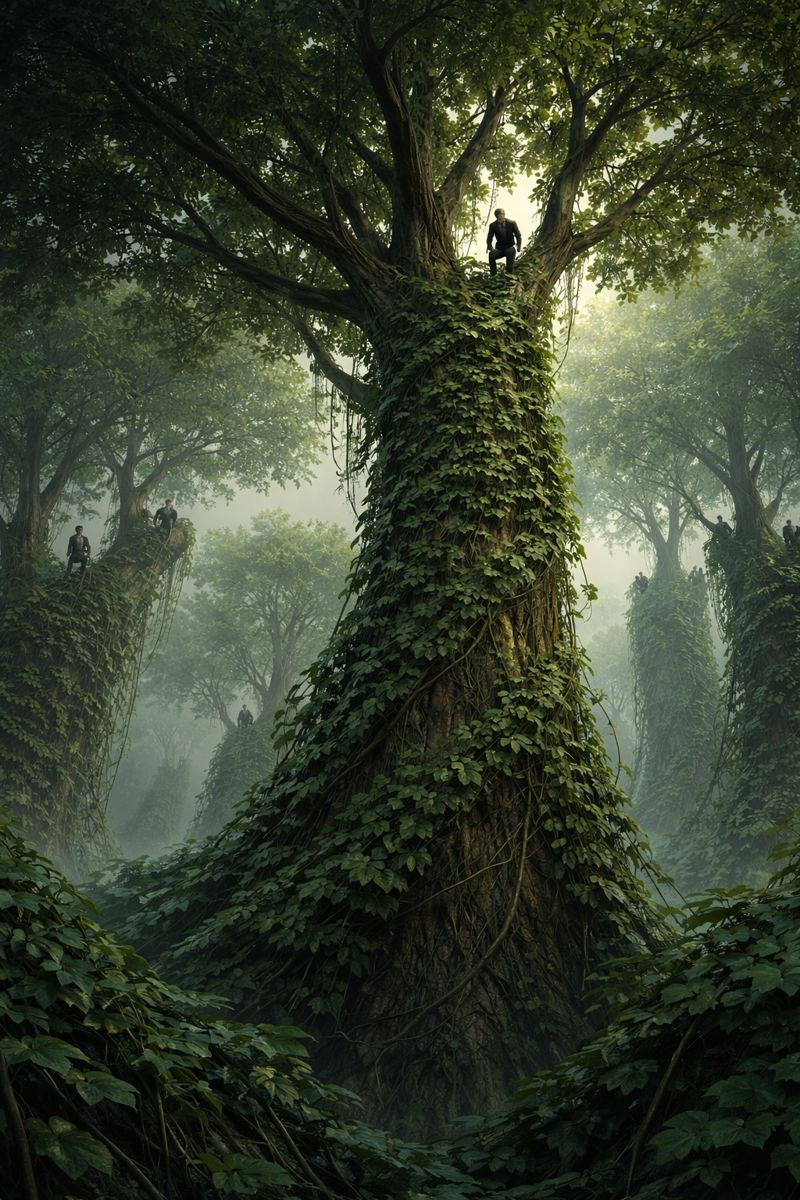
And if you’ve ever seen kudzu, you already know what happens next.
At first, it’s almost charming. A little green on the fence line. A soft invasion at the edges of the yard. The attorney (insert knowledge professional here), perched high in the canopy of education and credentials, looks down and shrugs. The vine is eating the low bushes, the simple tasks, the junior work. Someone else’s problem.
Then it touches their trunk. Not the top branches, just the trunk (e.g., intake memos, first drafts, research, standard filings, etc.). The repetitive work that quietly funds the profession and trains the next generation slowly becomes overtaken by the green vine of synthetic knowledge. The attorney doesn’t scream, though. They just scoot higher, telling themselves the canopy is different. Surely the vine can’t live at this lofty altitude. It took too long for their tree to grow that high, and for them to climb it.
Then they look across the forest. They see the occupants of the health care tree shifting their weight upward, still trying to pretend it’s nothing. They glance over at the financial services tree and see accountants and bankers doing the same, eyes fixed downward as green wraps around more and more bark. Each tree in the forest is whispering the same comfort: it won’t climb my tree. It won’t reach my branch. It took me years to climb this high; surely I have time! Then everyone looks over at the software engineer tree.
The vine is already higher there. Uncomfortably high. High enough to erase the illusion that this is only about “low-level work.” High enough to force the question the whole forest has been avoiding: If it climbed that trunk, why wouldn’t it climb mine?
That’s the thing about kudzu. It doesn’t negotiate. It doesn’t care how proud the tree is. Technically, it doesn’t “care” at all because it has no feelings, no morals, no values. It doesn’t need them to be perfect. It just needs to grow. And it grows a hell of a lot faster than trees do.
So, the forest does what forests always do when they feel powerless: it invents stories. It tells itself the vine will stop. That the top is too complex. That the canopy is sacred. That credentials are armor. That creativity is different. That physical work is safe.
But the vine keeps moving. Because the vine is not after “jobs.” It’s after steps. Anything that can be standardized. Anything that can be learned from examples. Anything that can be repeated. And once it eats enough steps, the job is just a costume hanging on an empty hook.
The popular consensus among all of the world’s leading minds on the subject is that, eventually, that vine will reach the top. Granted, they disagree on how long that will take, but that horizon is not outside of our lifetimes in nearly all cases. Then the question stops being economic and becomes existential. If AI commoditizes knowing, and robots commoditize doing, what branches do humans have left to claim as our own? Maybe it’s ownership. Whoever owns the land, the rails, the machines, the channels. Not skill, but claim. Not craft, but stake. Maybe it’s trust. Not the ability to produce answers, but the right to be believed in a world flooded with plausible noise. Maybe it’s purpose. The strange human capacity to suffer, to love, to care, to choose what matters even when nothing forces us to.
Or maybe the darker answer is the true one. Maybe, in purely economic terms, there is nothing left. And if that’s the case, then the forest is no longer debating careers. It’s debating a new kind of future. One where humans are not valuable because they’re necessary, but only because they’re, well…human. But what does that mean? THAT is the question we should be asking ourselves right now!
The tree is not dead. Not yet. But no one can argue that the silhouette has changing, and that the vines are already much higher than most people want to admit.

0 Comments