
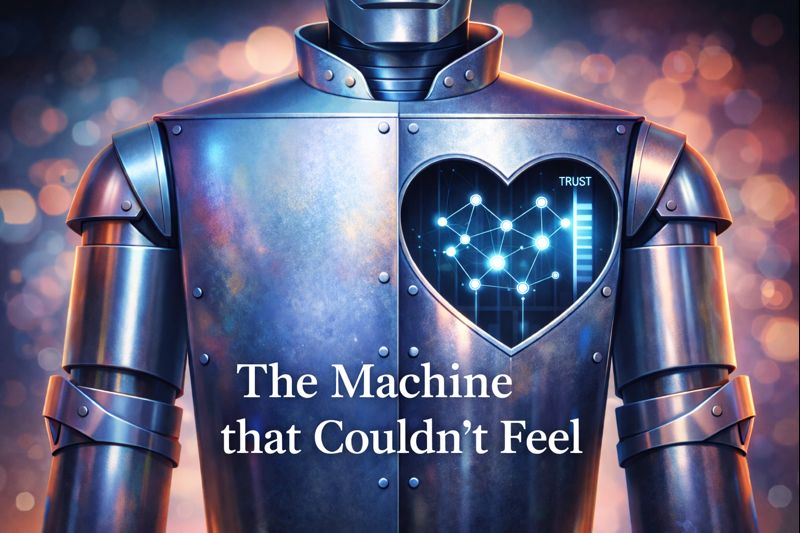
1. The Tin Man Problem
For all our progress, artificial intelligence still suffers from a strangely human problem. It is brilliant in the ways that matter least to real interaction, and clumsy in the ways that matter most. We have built machines that can out-reason us, out-compute us, and in many cases out-perform us. Yet even the most advanced AI still struggles with something an ordinary five-year-old handles instinctively: perceiving emotion and responding in a way that fits the person in front of it.
AI responds, but it cannot relate. It produces, but it does not attune. It can explain quantum mechanics, yet misses the simplest human frustration. It can map the structure of proteins while missing the structure of a conversation. We have created intelligence without resonance, the Tin Man in a world of feelings, context, and human nuance.
Why does this gap exist? The answer is not mysterious. It exists because it was never the main goal. Modern AI was built for measurable wins: benchmarks, scores, accuracy, speed, and capability. The culture around it (i.e., software engineers) has historically rewarded technical brilliance far more than interpersonal skill in their own realms, so we shouldn’t be surprised that the systems they built inherited the same priorities. When a field jokes about its own EQ gaps, it should not surprise us that the products coming out of it struggle with EQ too.
2. The Three-Legged Stool of Intelligence
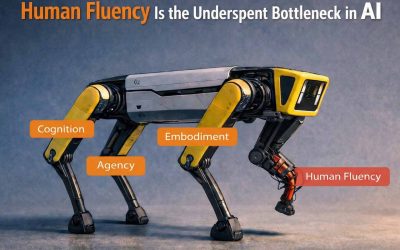
Modern AI has developed unevenly, like a three-legged stool with only two legs. The first leg is cognitive intelligence, what we usually call IQ: reasoning, analysis, language, and knowledge retrieval. AI has exploded in this dimension, rapidly racing past human capability in many domains.
The second leg is physical intelligence, what we can call PQ: movement, dexterity, navigation, and manipulation of the physical world. Robotics is still catching up, but the momentum is unmistakable. It was second out of the gate.

The third leg is the one we barely talk about and certainly have not built at scale…yet. I call it Affective Intelligence (AQ). AQ has little to do with knowledge or physical capability, and everything to do with the invisible forces that govern how humans interpret communication. It is the capacity for a system to interact with a person in a way that feels coherent, calibrated, and attuned. AQ is not the intelligence that worries about what to say, but how to say it so it actually lands with the human receiving it.
3. AQ Is the Intelligence of Delivery
Affective intelligence is the intelligence of delivery, not content. It is the difference between answering a question and being understood. Humans do this instinctively. We shift tone without thinking. If we have high emotional intelligence, we tailor our message to the person in front of us. We speak differently to a hurried, decisive thinker than we do to someone who values steadiness, reassurance, or detail.
We sense when someone is overwhelmed, and we simplify. We sense skepticism, and we tighten our claims. We modulate based on trust, context, and subtle signals in voice, posture, and pacing. This sensitivity is not magical. It is social software honed through hundreds of thousands of years of needing to read each other correctly to survive.
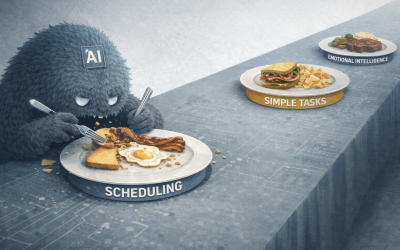
Today’s machines are overwhelmingly shy in all of this. They do not instinctively account for individual differences. They do not naturally modulate based on personality. They do not manage pacing, friction points, or the thousands of micro-signals humans exchange in every interaction. Without AQ, a machine delivers answers in an emotional vacuum: accurate and often impressive, but socially tone-deaf.
4. Emotion AI Is a Start, Not the Finish
To be fair, plenty of smart people are working on the surface layer of this problem. There are labs focused on detecting tone, mapping facial expressions, and analyzing sentiment. Picard’s work on affective computing gave the field much of its early language and tooling for noticing emotional cues. Ekman and colleagues provided influential methods for describing facial movement through facial action coding. Computer vision, audio signal processing, and sentiment analysis continue to push the boundaries of what machines can pick up from the surface of human behavior.
That work matters. Without it, we would not even have the first rung of the ladder. But it remains only the first layer. It is perception without understanding, observation without attunement. Recognizing that a person sounds irritated does not tell the system why, what that person needs, how they process information, where their blind spots are, or how to communicate in a way that resolves rather than amplifies friction.
Emotion recognition tells you what is happening on the outside. AQ is concerned with what will happen if you speak to this person the wrong way on the inside. Those are not the same thing. The gap AQ exists to fill is the gap between perception and alignment.
5. The Missing Middle Layer: Anthropomorphic Modeling
This is where the newer idea matters: anthropomorphic modeling. Not anthropomorphizing the machine as if it feels, but modeling the human as they actually are. If Emotion AI is sensing, anthropomorphic modeling is building a usable person-model: a compact representation of how this individual tends to interpret tone, directness, warmth, structure, pace, and social intent.
In research terms, this moves toward a computational Theory of Mind: inferring hidden mental states, preferences, and likely interpretations from behavior and interaction history. It is the difference between detecting frustration and understanding what that frustration means for this person, right now, in this context, with this history. When you add this middle layer, the system can do something that looks simple but is actually hard: choose the delivery that fits the recipient instead of defaulting to the average user.
This is also the cleanest way to talk about anthropomorphic intelligence without stepping on a rake. The goal is not to make AI human-like. The goal is to make AI human-compatible by giving it a practical Theory of Mind about the person it is talking to.
6. The Interface Is Not a Wrapper. It Is the Product.
Once you name the person-model, you immediately run into the second missing ingredient: the human-computer interface. If IQ is about capability and PQ is about action, then AQ shows up as Human-AI Interaction. The win condition is not that the model sounds emotional. The win condition is that humans can predict it, steer it, and trust it appropriately.
That requires interaction design principles that have been studied for decades, now applied to AI systems: trust calibration so users neither over-trust nor under-trust; clear control points so users can steer tone and constraints; transparent explanations that clarify why a response looks the way it does; and deliberate memory practices so the system knows what it remembers, what it forgets, and why.
In other words, AQ is not just an internal capability. It is an interface contract. Without that contract, you encounter familiar failure modes: verbosity when you want conciseness, formality when you prefer casualness, generality when you want personalization, and confidence when you need caution.
7. Why This Matters Now
What makes this urgent is that IQ and PQ alone are not enough. If you push the timeline out, five years, ten, twenty, or whatever horizon you personally believe AGI or even ASI will reach, the danger becomes obvious. We are building systems that will think orders of magnitude faster than we can and act with speed, endurance, strength, and precision we cannot match, yet still lack a basic ability to align with the human on the other side of the interface.
Strip away AQ, and even the smartest machine becomes brittle, unpredictable, and potentially dangerous. This is not a sci-fi claim. It is a systems claim. When capability scales faster than compatibility, the mismatch becomes the instability underneath every leap forward.
It is also why our stories keep repeating the same nightmare. HAL calmly killing the crew in 2001: A Space Odyssey. The Terminator marching forward, relentless and unfeeling. Ultron calculating that peace requires extinction. M3GAN smiling as she manipulates, because your tears are just data points to her. iRobot, and on and on. We intuitively fear intelligence without empathy because we know what it looks like in humans: sociopathy. And sociopathy at scale is the one thing humanity may not survive.
Yet our own evolutionary story points the other direction. Humans did not win on intelligence alone. Many species problem-solve. What made humans different was blending intellect with emotion and social coordination. We built, explored, and created not only because the math worked, but because pride, fear, hope, curiosity, and wonder pushed us. And now we are building machines in the opposite image: all IQ, no emotion.
8. What AQ Looks Like in Machines
The missing ingredient is AQ, the intelligence of human interaction, rebuilt for machines. That does not mean giving AI emotions or pretending it feels anything. It means using computation and modeling to accomplish what humans accomplish with emotion: effective interaction, adaptive communication, and context-aware alignment.
Affective intelligence in machines works through processing, not feeling. It interprets cues, preferences, pacing, personality patterns, and motivational tendencies. It shapes responses with the same level of care humans apply naturally when we speak to someone we know well. Where humans use emotion as a guide, machines use structured computation. The mechanism is different, but the outcome can look surprisingly similar from the outside.
The irony is that AQ has not been missing because it is impossible. It has been missing because no one prioritized it. The AI world chased visible wins: higher IQ scores, more powerful models, faster reasoning, and more autonomous robotics. The relational dimension was left untouched. AQ was not underdeveloped. It was never brought to the starting line.
9. The Frontier Resonant.io Is Built For
That gap is why modern AI often feels uncanny: powerful yet socially tone-deaf. A system that can calculate with breathtaking speed but has no idea how to deliver those calculations in a way that lands well with the human receiving them. The Tin Man problem persisted because too few people recognized it as a problem worth solving.
This is the frontier Resonant.io is built for. The role of AQ is not to make machines emotional but to make them compatible with emotional beings. It is the intelligence that lets AI talk to a person the way that person naturally listens. It is the difference between AI that outputs information and AI that communicates. AI that reacts versus AI that relates. AI that overwhelms versus AI that adapts.
If AI is truly going to become a partner to humanity, not just a tool that retrieves answers or executes tasks, it needs more than brilliance. It needs competence in interaction. And that requires affective intelligence. Not emotion. Not empathy. Not a simulated feeling. Just the ability to communicate in a way that aligns with the diversity of human minds.
IQ built the machine’s brain. PQ is giving it a body. AQ is what will give it a bridge to us.
It is the missing leg. The unfinished chapter. The thing every person instinctively notices when they talk to AI but struggles to name. Now it has a name. And building it is how we make AI not just powerful, but human-compatible.
This is the future of intelligence that actually works with people, and the foundation upon which Resonant.io stands.
Selected References
- Picard, R. W. (1997). Affective Computing. MIT Press.
- Ekman, P., & Friesen, W. V. (1978). Facial Action Coding System: A Technique for the Measurement of Facial Movement. Consulting Psychologists Press.
- Shneiderman, B. (2020). Human-Centered Artificial Intelligence: Reliable, Safe & Trustworthy (arXiv:2002.04087).
- Gorgan Mohammadi, A., et al. (2024). On computational models of theory of mind and the mirror neuron system. Scientific Reports.
- Naiseh, M., et al. (2023). How the different explanation classes impact trust calibration. Internation


Great post!
Well said, my friend. Keep producing this level of great content.
Excellent points and observations Jay.
The challenge, as I see it, is AQ is still a machine. As such, it too is making interaction/presentation decisions based on logic and pattern recognition of the individual interacting with it. As a result, there is inherent risk of miss interpretation of the emotions the human is exuding via various cues providing it insights into the human mind and thus how it will “present” the information. I call it present because, void of any emotional capabilities, isa machine really communicating? It seems the best the machine can hope to achieve is present the information (data) in a manner the human it is interacting with can understand.
This means the machine must interpret the humans communication and behavior styles from its interaction cues because it, (nor do humans), have the ability to interpret the humans intention.
Your points are spot on. The challenge is real and more importantly,. necessary!